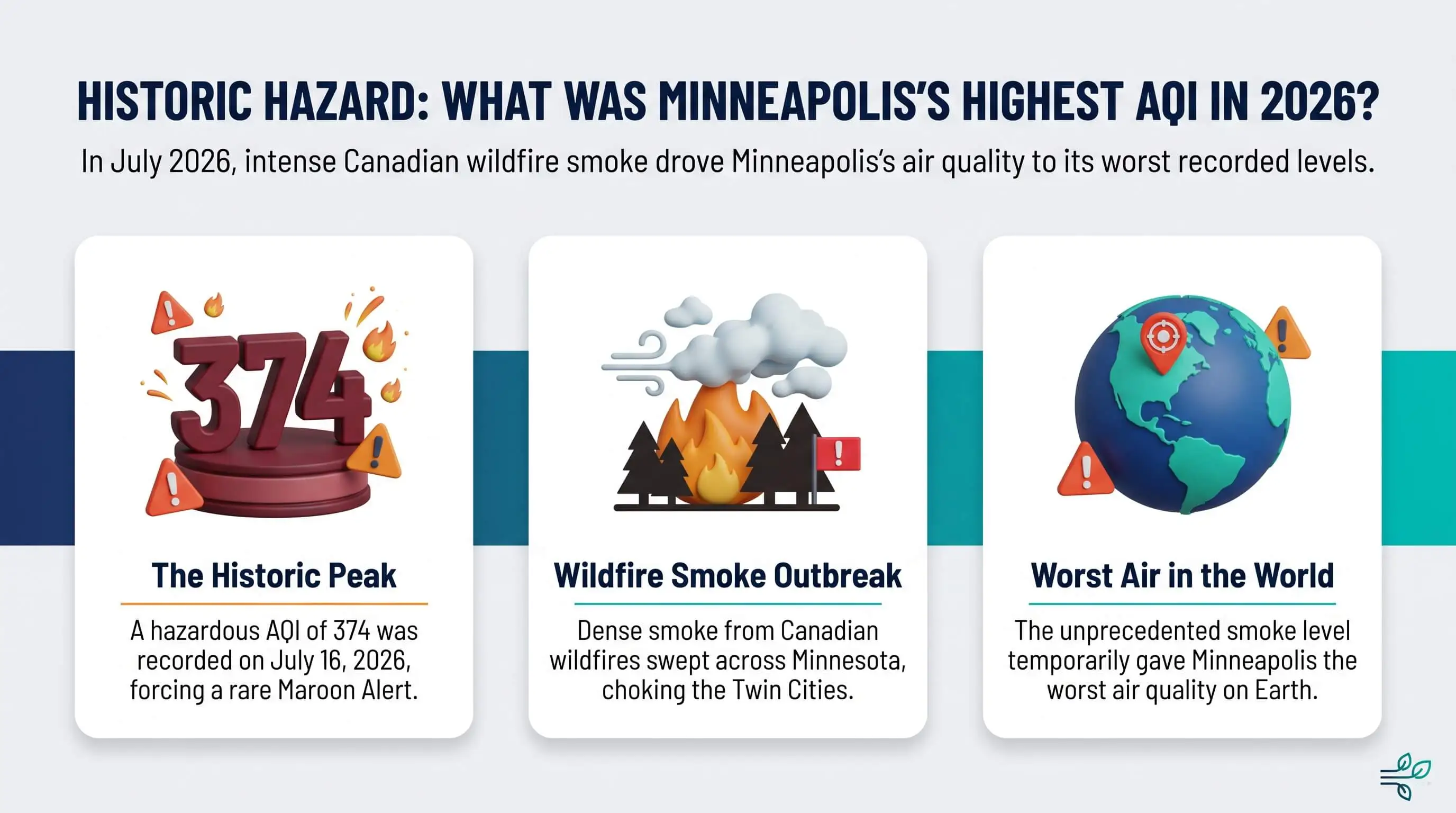
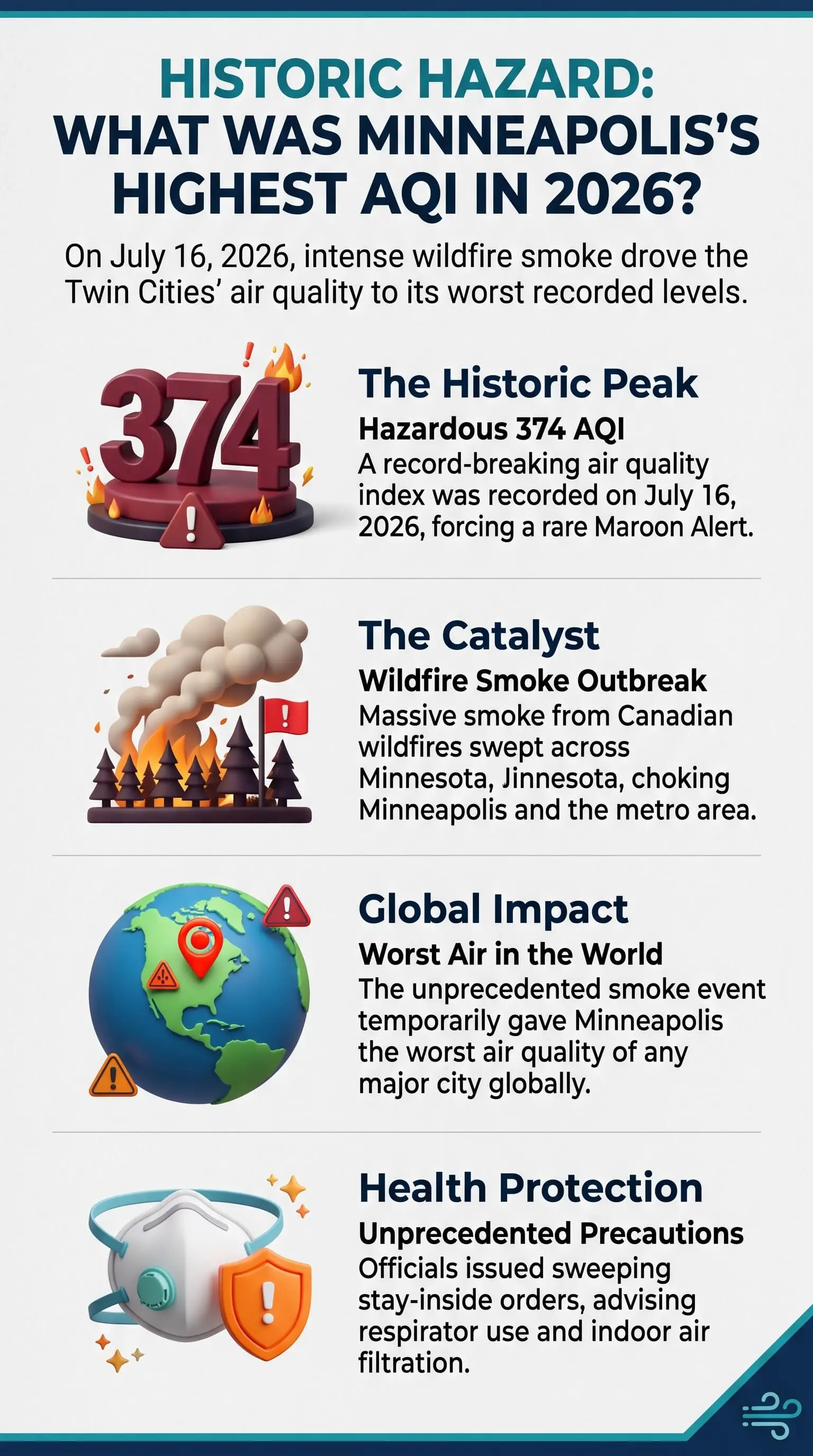
By Thursday afternoon, July 16, 2026, Minneapolis had the dirtiest air of any major city on Earth. Wildfire smoke pushed the AQI past 300 overnight, into the hazardous range, and some sensors in the city read close to 460. That makes it the highest recorded AQI in Minneapolis this year. On a normal summer day, the Air Quality Index here sits between 20 and 50.
Anyone could see the orange sun from the sidewalk. What you couldn't see was how far apart the official numbers landed. I tracked the AQI Minneapolis readings from the first alert to the all-clear, and that gap surprised me more than the peak did. If you're the one deciding when to close the windows at home, the gap matters.
TL;DR Quick Answers
AQI Minneapolis
AQI Minneapolis readings sit between 20 and 50 on a normal summer day. The 2026 high came on July 15 and 16, when wildfire smoke pushed the Twin Cities metro past 300 into hazardous air for the first time on record. Smoke can flip that number within hours.
Normal range: Good to moderate most of the year, with winter inversions nudging fine particles higher on cold, still mornings.
2026 peak: July 15 and 16, hazardous (AQI 301 and above), driven by smoke from wildfires near the Boundary Waters and in Ontario.
Record reading: A monitor in Blaine logged 342.8 µg/m³ of PM2.5, beating the old Twin Cities record by a wide margin.
Main pollutant: Fine particles (PM2.5), which you can’t see but which slip indoors through window gaps and attic floor leaks.
When to act: Sensitive groups should act at 101 and everyone else at 151. Above 300, stay inside.
Indoor defense: Close the windows and run a MERV 11 or the best filter your system allows. Then seal the attic floor so the stack effect stops pulling smoke inside.
Top Takeaways
Minneapolis recorded its worst air on July 15 and 16, 2026, when the metro reached the hazardous range for the first time on record.
Reported peaks run from AQI 374 citywide to about 460 at single sensors.
A Blaine monitor set a Twin Cities PM2.5 record of 342.8 µg/m³, past the top of the AQI scale.
Minnesota summer air normally sits between 20 and 50, so the jump ran more than sixfold.
Sealing the attic floor cuts the stack effect that pulls smoke into your living space.
The July 2026 Smoke Event That Set the Record
How Wildfire Smoke Reached Minneapolis
Lightning started it. Beginning July 7, fires broke out in and around the Boundary Waters, and by July 16 they had burned more than 50,000 acres with little containment while fires in Ontario fed the same plume. The densest smoke rode south on Wednesday, July 15, and reached the metro late that evening.
The Minnesota Pollution Control Agency (MPCA) had already put the Twin Cities under an alert running from 2 p.m. July 15 to 11 a.m. July 17. It forecast very unhealthy (purple) air for the metro. The smoke beat that forecast by a full category.
The Readings on July 15 and 16
Above 300: On Thursday, July 16, the Twin Cities metro reached the hazardous category for the first time on record, according to the Minnesota State Climatology Office.
AQI 374: IQAir ranked Minneapolis's air the worst of any major city in the world that afternoon.
Near 460: National news outlets reported readings near 460 in parts of the city.
342.8 µg/m³: A monitor in Blaine logged a fine-particle (PM2.5) concentration that beat the old Twin Cities record by a wide margin, MPR News reported. The MPCA lists it as provisional until lab analysis wraps up.
A First for the Twin Cities
Organizers canceled youth camps and a concert. The MPCA's advice for hazardous air was blunt: everyone should stay indoors and skip outdoor activity altogether. Relief came Friday morning, July 17, when a cold front dropped the metro back to moderate. Northeastern Minnesota stayed hazardous.
Why Sources Report Different Peak AQI Numbers
Open three air quality apps and you'll probably find three different peaks for that week, each one accurate for what it measures.
One sensor or the whole city. IQAir's 374 blends readings from many stations. The reports near 460 came from individual sensors, and a monitor parked under the thickest smoke will always read higher than an average.
The latest hour or the full day. Live maps run on a NowCast that leans hard on the most recent hours, so they jump the moment smoke arrives. The official daily AQI averages 24 hours and flattens those spikes, which means a record hour and a record day can carry very different numbers.
A concentration or an index. Blaine's 342.8 measures micrograms of fine particles per cubic meter of air, not an AQI score. Under the EPA's 2024 update, fine-particle pollution turns hazardous at 225.5 µg/m³, and the top of the scale, an AQI of 500, sits at 325.4 µg/m³. Blaine ran past the point where the index stops counting.
Where the monitor sits. Blaine is a north-metro suburb, so its reading is a Twin Cities record rather than a Minneapolis-only one.
When someone quotes "the" record now, I ask which monitor and which time window. That clears up most of the confusion. The same applies to AQI meaning, since air quality readings can vary depending on the monitoring location and the time period measured.
How 2026 Compares With Earlier Minnesota Smoke Years
Smoke pushed parts of the state above an AQI of 200 for the first time in 2021. Two years later, the state logged nearly 50 air quality alerts. And 2025 brought the smokiest year in five decades, measured by how often the air turned bad.
What set 2026 apart was intensity. The Minnesota State Climatology Office called the July outbreak the most intense smoke pollution on record in the state and likely the worst in at least 50 years. I keep an eye on both measures, because frequency tells you how often to stay alert while intensity shows how bad a single afternoon can get.
Other High AQI Days in Minneapolis in 2026
The peak didn't arrive alone. On July 14, the first alert of the outbreak expanded to the metro with red (unhealthy) air in the forecast, and heavy smoke came back July 19 and 20, when the MPCA issued a second red alert for the Twin Cities. Most other days this year stayed in the good to moderate range. Winter inversions nudged fine particles higher on cold, still mornings.
How to Check AQI Minneapolis Conditions Today
Yesterday's forecast won't help when smoke turns a green morning red by lunchtime. Check a live AQI map for Minneapolis before you plan time outside, and sign up for the MPCA's EnviroFlash alerts so a bad-air day reaches your phone before it reaches your lungs. Then know your lines. Sensitive groups should act at 101, everyone else at 151. Above 300, stay inside.
Why Smoke Gets Inside on Hazardous AQI Days
Don't take the air inside your house for granted, because the house breathes. Warm air rises and slips out near the roof, and that creates a gentle suction that draws outdoor air in through gaps lower down. Building scientists call it the stack effect. On a hazardous day, that incoming air carries smoke you can't see.
Many of those gaps hide in the attic floor, around recessed lights, at the attic hatch, through plumbing and wiring holes, and along the top plates of interior walls. Insulation slows heat, but air moves right through it. Gray or dark streaks in the insulation show where.
Here's what I'd do.
Close windows and doors as soon as the MPCA issues an alert.
Switch your HVAC to recirculate so it stops pulling in outdoor air.
Run a MERV 13, the rating the EPA points to for smoke, or the highest-rated filter your system can handle.
Before next season, seal the attic floor gaps and lay the insulation back over them. If coverage looks thin, consider upgrading your attic insulation at the same time.
For a layer-by-layer walkthrough of smoke maps, the Oregon smoke map guide on this site works just as well for Minnesota maps.
"After a heavy smoke event, I pull back the insulation around recessed cans and the attic hatch, and the dark streaks show exactly where the house was pulling outdoor air. Seal those gaps before the next alert, because the stack effect draws smoke through them every time the AQI climbs."
7 Essential Resources
Minneapolis Real-Time AQI Tracker: Current readings, AQI categories, and filter guidance matched to the level outside.
MPCA Air Quality Alert, July 15 to 17, 2026: The agency's official alert, its category map, and who it told to stay indoors.
Dangerous Smoke Outbreak, July 14 to 17, 2026: How the State Climatology Office documented the record readings, Blaine included.
EPA PM2.5 Air Quality Index Fact Sheet: The 2024 breakpoints that decide where each fine-particle AQI category starts.
National Weather Service Air Quality Safety: How forecasters predict ozone and particle pollution.
CDC: Who Is at Risk From Wildfire Smoke: Which family members smoke hits hardest.
DOE: Air Sealing Attic Access: Plain steps for sealing attic hatches and pull-down stairs.
3 Statistics
The Twin Cities earned an F for short-term particle pollution. The American Lung Association ranked the metro 39th worst in the country, and Hennepin County averaged 4.5 unhealthy particle days a year. Source: American Lung Association, State of the Air 2026
Wildfire smoke hits lungs harder than everyday particles. A Southern California study found that a 10 µg/m³ rise in wildfire PM2.5 raised respiratory hospitalizations by about 1.3% to 10%, compared with roughly 0.67% to 1.3% for fine particles from other sources. Source: Nature Communications via PubMed Central
Small leaks add up fast. ENERGY STAR estimates that the gaps in a typical home's outer shell equal a window left open every day of the year, and 9 in 10 U.S. homes don't have enough insulation. Source: ENERGY STAR
Final Thoughts and Opinion
I don't think the exact peak matters as much as how fast the air turned. Minneapolis went from an ordinary July evening to hazardous air overnight, and nobody got a full day to prepare.
That's why I check the AQI as often as the weather from May through September. I'd also argue the attic is the most overlooked smoke defense in a Minnesota home. Seal it on a clear fall afternoon, and the next alert finds your family, your home, and your HVAC system already protected. Checking your air filter's MERV rating helps ensure it can capture fine particles from wildfire smoke while remaining compatible with your HVAC system.
Frequently Asked Questions
What Was the Highest AQI in Minneapolis in 2026?
The worst readings came on July 15 and 16, 2026, during a wildfire smoke outbreak. IQAir measured a citywide AQI of 374, news outlets reported sensors near 460, and the metro hit the hazardous category for the first time on record.
Was July 2026 the Worst Air Quality in Minnesota History?
By intensity, yes. The Minnesota State Climatology Office called it the most intense smoke pollution on record in the state. The MPCA still lists the new concentration records as provisional.
Why Did Minneapolis Rank Worst in the World for Air Quality?
Dense smoke from wildfires in northeastern Minnesota and Ontario settled over the metro on July 16. That afternoon, Minneapolis posted a higher AQI than any other major city IQAir tracks.
What AQI Level Counts as Hazardous?
Any AQI from 301 to 500 counts as hazardous, and maps show it in maroon. For fine particles, the EPA's 2024 breakpoints start that range at 225.5 µg/m³. At this level, everyone should stay indoors and skip physical activity outside.
How Can I Keep Wildfire Smoke Out of My Home?
Close the windows, set your HVAC to recirculate, and run a MERV 13 or the best filter your system allows. Then seal the attic floor leaks that feed the stack effect.
Plan for the Next Hazardous AQI Day
Minneapolis hit its highest recorded AQI of 2026 in less than a day, so the plan that protects your family is the one you make on a clear morning. Check the live reading before you head out, and seal the attic gaps that pull smoke inside well before the next fire season. Choosing the right home air filter helps capture fine particles that enter your home, keeping indoor air cleaner during wildfire smoke events.


